
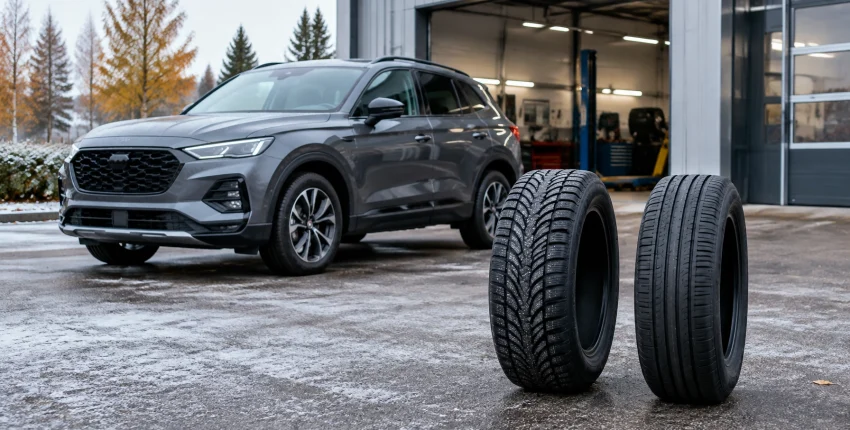
If you drive in Moses Lake, you may be wondering whether this is the year to buy winter tires, or whether your current all-seasons are still up to the job.
The honest answer is that all-season tires are genuinely fine for many drivers. If your driving is mostly local, your tires are in good condition, and you can avoid traveling during the worst weather, you may not need a dedicated winter set.
But tread depth is only part of the decision. Tire rubber changes as temperatures fall, and the compound, tread design, driving schedule, and road conditions all affect how much grip you have. Drivers who regularly leave early in the morning, travel on I-90, deal with ice, drive hills, tow, or need dependable winter control may benefit from winter tires or a quality all-weather tire with the Three-Peak Mountain Snowflake symbol.
Moses Lake’s first frost typically arrives around mid-October, making this a good time to make a plan before cold mornings and icy pavement become part of your routine.
Start With Your Driving Conditions
Before choosing a tire type, think about how and when you drive. The same tire can be a reasonable choice for one driver and a poor fit for another.
All-seasons may be enough if you:
- Primarily drive during daylight and on treated roads
- Can delay trips when snow or ice is expected
- Have newer tires with strong, even tread
- Drive mostly around Moses Lake
- Do not regularly tow or carry heavy loads in winter
- Rarely travel on I-90 during freezing conditions
Winter or all-weather tires deserve stronger consideration if you:
- Leave home before roads have warmed or been treated
- Frequently drive on packed snow, black ice, or icy intersections
- Travel on I-90 during early-morning or winter weather conditions
- Drive hills or rural roads where traction can change quickly
- Commute on a fixed schedule and cannot wait for better conditions
- Tow a trailer or carry substantial cargo
- Want the greatest possible braking and cornering control in cold weather
Your vehicle’s all-wheel-drive or four-wheel-drive system does not eliminate the need for appropriate tires. Those systems can help you accelerate, but they do not create extra braking grip on ice.
Why Temperature Matters More Than Tread Depth Alone
Many drivers know to check tread depth, but tire compound matters just as much. Summer and many all-season compounds become less flexible as temperatures drop. A commonly used rule of thumb is that performance can begin changing around 45°F, or 7°C.
That number is not a precise switch that suddenly changes every tire’s behavior. Tire designs differ, and pavement conditions matter. Still, it helps explain why a tire with plenty of visible tread may not perform like a winter tire on a cold, icy morning.
Winter tires use a rubber compound designed to stay more pliable in lower temperatures. Their tread patterns also include more biting edges and narrow grooves, called sipes, to help grip snow and cold pavement.
This is why a winter tire can provide better cold-weather traction even when an all-season tire appears to have similar tread depth.
All-Season, All-Weather, or Winter Tires?
The names can be confusing, so it helps to separate the three common categories.
All-season tires
A good all-season tire is designed to handle a wide range of conditions, including dry pavement, rain, and occasional light snow. For many drivers in Moses Lake, a newer all-season tire with good tread and proper inflation is a practical year-round choice.
However, “all-season” does not automatically mean excellent snow or ice performance. Check the sidewall for the M+S marking and review the tire manufacturer’s information. M+S is useful, but it is not the same as the severe-snow rating represented by the Three-Peak Mountain Snowflake symbol.
All-weather tires
All-weather tires are built for drivers who want one set of tires but need more cold-weather and snow capability than many standard all-seasons provide.
Look for the Three-Peak Mountain Snowflake, also called the 3PMSF symbol. It indicates that the tire has passed a standardized severe-snow traction test. It does not mean the tire is unstoppable on ice, but it is a more meaningful indicator of winter-snow capability than the words “all-season” alone.
An all-weather tire may be a good compromise if you want stronger winter performance without buying and storing a second set.
Dedicated winter tires
Dedicated winter tires generally provide the strongest performance in repeated snow, ice, and cold conditions. They are often the better option for drivers who must travel regardless of weather or who regularly face early-morning freezing pavement.
The trade-off is that winter tires are not intended for warm-weather use. Running them through spring and summer can cause faster wear, more road noise, and less precise handling on warm, dry pavement.
The Real Trade-Offs of Switching Tires
Winter tires offer an important traction advantage, but they are not automatically the right financial or practical choice for everyone.
Warm-weather wear
Winter compounds are softer. When used in warmer conditions, they can wear faster than intended. This is one reason to remove them when consistently warmer weather arrives.
Noise and ride feel
The deeper, more heavily siped tread found on winter tires may create more road noise. Some drivers notice a softer or less sharp steering feel compared with their regular all-season tires.
Cost of a second set
Buying winter tires usually means paying for two tire sets over time. If you purchase a second set of wheels, seasonal changeovers become simpler and can reduce repeated mounting and demounting costs. You will also need a clean, dry place to store the tires when they are not in use.
Seasonal changeover timing
A practical approach is to install winter tires before overnight temperatures regularly stay near the mid-40s or before your first expected snow and ice events. Remove them when winter conditions have passed and temperatures are consistently warmer.
The goal is not to wait for the first storm. It is to prepare before you need the extra traction.
What About Studded Tires in Washington?
Studded tires can provide strong traction on packed snow and ice, but they also come with legal and practical considerations.
In Washington, studded tires are generally legal from November 1 through March 31. The Washington State Department of Transportation notes that the permitted period can be extended when conditions warrant, but you should not assume an extension will occur. You can review current information in WSDOT’s studded-tire guidance.
Studs also contribute to road wear. For that reason, some drivers choose studless winter tires, which can provide excellent cold-weather and snow traction without metal studs. If you are considering studded tires, check current Washington requirements and think about how often you actually drive on ice.
Whatever winter tire you choose, install the appropriate tire type on all four wheel positions unless your vehicle manufacturer specifically states otherwise. Mixing winter and non-winter tires can create unpredictable handling.
Check Tread Depth Before Making a Decision
Tread depth helps determine whether your current tires still have useful winter capability, but the legal wear limit is not the same as a comfortable safety margin.
A tire may be legally worn until the tread reaches 2/32 inch, but you should not wait until the wear bars are level with the tread before thinking about winter traction. Snow performance generally declines as tread wears down.
As a practical guide:
- Around 8/32 inch or more: stronger starting point for winter use
- Around 6/32 inch: inspect closely and consider how severe your driving conditions are
- Around 4/32 inch or less: winter traction may be noticeably compromised
- At 2/32 inch: the tire is worn out and should be replaced
Measure in several grooves rather than checking only one spot. Also look for cracking, bulges, cuts, plugged damage, and uneven wear. The U.S. Tire Manufacturers Association tire care guidance recommends regular inspection and emphasizes that tire condition involves more than tread depth alone.

Do Not Forget Cold Tire Pressure
Cold weather lowers tire pressure. A commonly used estimate is roughly 1 PSI for every 10°F drop, although the actual change can vary. USTMA guidance describes a possible change of about 1–2 PSI per 10°F.
Check your tires when they are cold, ideally before driving or after the vehicle has been parked for several hours. Inflate them to the pressure listed on the driver’s door-jamb label or in your owner’s manual, not the maximum pressure molded into the tire sidewall.
Underinflation can reduce handling, increase wear, and contribute to tire damage. A tire pressure monitoring system is helpful, but it should not replace manual pressure checks.
A Tire Changeover Is Also a Good Inspection Opportunity
When you rotate tires or switch between seasonal sets, ask for more than a quick visual check. Uneven wear may point to an alignment or suspension problem rather than a defective tire.
Look for:
- Wear on only one edge of the tread
- Cupping or scalloped wear
- Feathered tread blocks
- A steering wheel that sits off-center
- Pulling to one side
- Vibrations at certain speeds
- Clunks or looseness over bumps
A tire changeover is a good time to check alignment angles, steering components, shocks, struts, and other suspension parts. Correcting the underlying issue can help your tires wear evenly and maintain more predictable contact with the road. If you have been searching for tire alignment in Moses Lake or a wheel alignment near me, an inspection can help determine whether alignment is actually the concern.
For related guidance, see our article on suspension repair in Moses Lake and our explanation of wheel alignment after suspension repair.
The Bottom Line for Moses Lake Drivers
All-seasons are enough for many drivers in Moses Lake when they are properly maintained, have good tread, and match your normal driving conditions. Winter or 3PMSF-rated all-weather tires make more sense when you regularly encounter cold mornings, ice, snow, hills, towing, or early-season I-90 travel.
Dedicated winter tires offer the most cold-weather capability, but they also involve seasonal changeovers, storage, additional cost, and faster warm-weather wear. Studded tires are another option, but Washington’s seasonal rules and road-wear concerns should be part of the decision.
If you are unsure, bring your vehicle to Best Buy Auto Service at 205 W Broadway Avenue, Moses Lake, WA for an honest tire and alignment check. Our local, family-owned team has more than 10 years of experience and provides transparent recommendations with fair pricing and no hidden fees. We offer friendly support in English and Spanish, so you can make a confident choice before winter conditions arrive.